Put out a fire without damaging what you protect
A gas fire suppression system puts out a fire in seconds without water, so servers, control panels, archives and equipment survive. DHAS designs, supplies, installs and maintains Siemens gas extinguishing systems in Lebanon, together with the fire detection that triggers them.
Fire protection has been part of DHAS’s work since 1973. When Siemens stopped supplying FM-200 systems, we moved to Novec 1230 (FK-5-1-12), which Siemens supplies instead.
This page is also a short guide: how gas suppression works, which agents are used today and why, what the standards ask for, and how to keep a system ready. The sources are listed at the end.
How a gas suppression system works
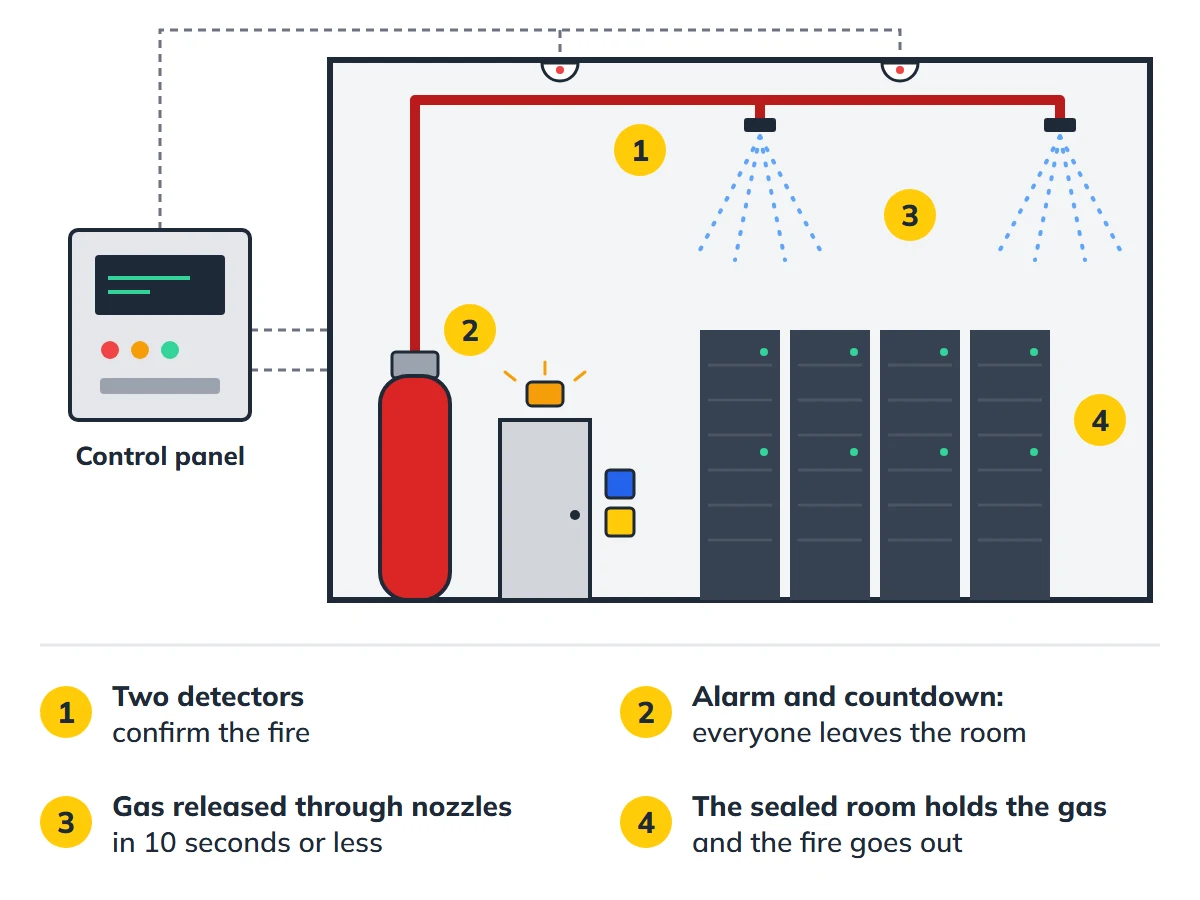
The steps match the numbers in the drawing above.
- Detection. Smoke detectors in the room, usually two that must both see smoke, confirm the fire. This prevents a release on a single false alarm.
- Alarm and countdown. Sounders and flashing lights tell everyone to leave. During a short countdown the system can close doors and dampers and stop the air-conditioning, so the gas stays in the room. An abort button holds the release; a manual release button starts it at once.
- Release. The agent flows from the cylinders through pipes to nozzles and fills the room in 10 seconds or less.
- Hold. The room stays closed while the gas puts out the fire. Afterwards the room is ventilated and the system is recharged.
Where gas suppression is used
Gas suppression protects rooms where water from sprinklers would cause as much damage as the fire itself:
- server rooms and data centres;
- telecom, control and UPS rooms;
- electrical rooms and switchgear;
- archives, libraries, record rooms and museums;
- medical equipment rooms in hospitals and clinics;
- any room with costly equipment that water would ruin.
The gas does not conduct electricity and leaves no residue, so there is nothing to clean up after a discharge.
FM-200, Novec 1230 and inert gases compared
Three families of agents are used to flood a room with gas:
| FM-200 (HFC-227ea) | Novec 1230 (FK-5-1-12) | Inert gases (IG-541, IG-55 and others) | |
|---|---|---|---|
| Type | Hydrofluorocarbon (HFC) | Fluoroketone | Natural gases: nitrogen, argon, sometimes CO2 |
| Global warming potential | 3,220 [1] | below 1 [1] | zero [2] |
| Ozone depletion potential | zero [1] | zero [1] | zero |
| How it puts out the fire | Mainly by absorbing heat from the flame | Mainly by absorbing heat from the flame | Lowers the oxygen in the room below what the fire needs |
| Outlook | Being phased down worldwide (see below) | 3M stopped making it; the same chemical is supplied by other manufacturers [2] | Natural gases, not affected by the HFC rules |
All three are electrically non-conductive and leave no residue. Inert gas systems need more cylinders, because a much higher concentration is used, but their piping can run further [2]. DHAS supplies Novec 1230 (FK-5-1-12) systems.
Why FM-200 is being phased down
FM-200 does not harm the ozone layer, but it is a potent greenhouse gas. Its global warming potential is 3,220 [1]: over a century, one kilogram released warms the planet about as much as 3,220 kilograms of CO2. HFCs like it are now being phased down:
- Worldwide: under the Kigali Amendment to the Montreal Protocol, adopted by 197 countries in Kigali in October 2016, countries agreed to cut HFC production and consumption by more than 80 percent over 30 years [3]. Lebanon ratified the amendment in February 2020 [4].
- United States: the AIM Act, enacted in December 2020, phases HFCs down to 15 percent of their baseline levels by 2036 [5][6].
- European Union: under the F-gas Regulation (EU) 2024/573, which applies since March 2024, HFCs will be phased out in the EU by 2050 [7].
A global HFC phase-down is expected to avoid up to 0.5 °C of warming by 2100 [6]. As supply shrinks, FM-200 becomes harder to find and more expensive to refill. Siemens, whose systems DHAS installs, stopped supplying FM-200 systems and supplies Novec 1230 instead, and DHAS followed.
What happened to Novec 1230?
Novec 1230 is 3M’s brand name for the chemical FK-5-1-12. In December 2022, 3M announced it would stop making all fluorinated fluids, as part of its exit from PFAS manufacturing by the end of 2025 [8].
That does not end the agent. FK-5-1-12 has the same chemical structure and fire-suppressing properties whoever makes it, and other manufacturers now supply it as a drop-in replacement for new and existing Novec 1230 installations [2]. The US EPA lists FK-5-1-12 as an acceptable total flooding agent [1].
For our clients, existing Novec 1230 systems stay in service and can be recharged with FK-5-1-12 approved for the system. We advise on the agent and its supply at the time of each project.
Already have an FM-200 system?
An existing FM-200 system can stay in service, but as the gas is phased down, refills become harder to find and more expensive. Plan the change when the system has discharged, is due for a major service, or the room is being rebuilt, not when you urgently need a refill.
FK-5-1-12 is used at a different concentration and stored differently, so a replacement is designed as a new system: we recalculate the agent quantity for the room, replace the cylinders and nozzles, check the pipework and the sealing of the room, and connect the release to the fire detection.
Is the gas safe for people?
Clean agents are designed to put out a fire at a concentration people can tolerate. The US EPA lists both FM-200 and FK-5-1-12 as acceptable total flooding agents, on condition that the safety guidelines of NFPA 2001 are followed [1], and FK-5-1-12 has acceptable toxicity for occupied spaces at its design concentration [2].
The system is still designed so that nobody stays inside: a pre-discharge alarm and countdown give time to leave, signs mark the protected room, and after a discharge the room is ventilated before people go back in. Inert gases work by lowering the oxygen in the room, so the same rules on alarms and evacuation apply.
The standards behind a gas system
- NFPA 2001, Standard on Clean Agent Fire Extinguishing Systems, published by the US National Fire Protection Association [9]. The US EPA refers to it for the safe use of clean agents [1].
- ISO 14520, the international standard for gaseous fire-extinguishing systems. Part 1 covers the design, installation, testing, maintenance and safety of total flooding systems that use electrically non-conducting agents leaving no residue [10]; further parts cover each agent.
Which standard applies depends on the project’s specification and its consultant. DHAS designs to the standard specified, as it does for fire alarm systems to the European or American norm.
Early detection for server rooms
A release is only as good as the detection behind it. DHAS installs Siemens fire detection to trigger the system: Cerberus PRO panels and detectors, and aspirating smoke detection, which draws air through pipes to a very sensitive detector and spots smoke long before a normal detector would. Read how Siemens ASD+ works.
The room’s panel can report to the building’s main fire alarm system, so the security team sees its status at all times.
Keeping the system ready
A gas system may wait years before it is needed, so it is checked on a schedule:
- Twice a year, the agent quantity and pressure of every cylinder are checked and logged. For halocarbon agents such as FK-5-1-12 and FM-200, a loss of 5 percent or more of the agent, or 10 percent or more of the pressure, means the cylinder must be refilled or replaced [11].
- The room itself is inspected for integrity and any new openings are sealed, because a room that leaks loses the gas too soon [11].
- Detectors, release circuits, sounders, abort and manual release buttons are tested.
- Changes to the room, such as new racks or cable openings, are reviewed against the design.
Our maintenance contracts cover these checks with scheduled visits.
How we work
- Consulting and site survey — our consultants study the site with you, explain the options and give demos where needed (consulting).
- Design — the agent quantity calculated for the room, with cylinders, pipework, nozzles, detection and release controls.
- Supply and installation — by DHAS technicians, with neat installation and on-site fine tuning (installation).
- Commissioning and handover — programming, testing, and training for the people who will use the system.
- Maintenance — maintenance contracts with scheduled visits keep the system at its best, extend its life and reduce false alarms (maintenance programs).
Frequently asked questions
Is the gas safe for people?
Yes, when the system follows NFPA 2001: the US EPA lists FM-200 and FK-5-1-12 as acceptable total flooding agents on that condition. The alarm and countdown still make sure everyone leaves before the release.
Will it damage our servers?
No. The agent does not conduct electricity and leaves no residue, so there is nothing to clean up.
Can we keep our FM-200 system?
Yes, an existing system can stay in service. But Siemens no longer supplies FM-200 and refills are becoming harder to find and more expensive, so plan the replacement before you need a refill.
Does the HFC phase-down apply in Lebanon?
Yes. Lebanon ratified the Kigali Amendment to the Montreal Protocol in February 2020, which commits it to phasing down HFCs such as FM-200.
Is Novec 1230 still available?
3M stopped making it, but the same chemical, FK-5-1-12, is supplied by other manufacturers as a drop-in replacement. We advise on the agent and its supply at the time of your project.
How fast does it work?
The agent is released and fills the room in 10 seconds or less.
Do we still need sprinklers?
Gas suppression protects a specific room. The rest of the building may still need sprinklers or other systems under the applicable codes, and we design the gas system to fit with them.
Sources
Checked on 4 November 2026.
- Substitutes in Total Flooding Agents (SNAP program), US Environmental Protection Agency, page updated 18 March 2026.
- 3M Novec 1230 Discontinued – What Now?, Fike Corporation.
- Recent International Developments under the Montreal Protocol, US Environmental Protection Agency.
- Lebanon is latest to ratify Kigali, Cooling Post, 6 February 2020.
- Background on HFCs and the AIM Act, US Environmental Protection Agency.
- Protecting our Climate by Reducing Use of Hydrofluorocarbons (fact sheet), US Environmental Protection Agency, 6 August 2021.
- F-gas legislation: Regulation (EU) 2024/573, European Commission, Climate Action.
- 3M to Exit PFAS Manufacturing by the End of 2025, 3M news release, 20 December 2022.
- NFPA 2001, Standard on Clean Agent Fire Extinguishing Systems, National Fire Protection Association.
- ISO 14520-1:2023, Gaseous fire-extinguishing systems: physical properties and system design, part 1, general requirements, International Organization for Standardization.
- Clean agent system inspection and test report (NFPA 2001), Seattle Fire Department.
Further reading on this site: FM-200 vs Novec 1230: replacing FM-200, EN 54-29 multi-sensor fire detectors, warehouse fire safety with Siemens ASD+.
Protect your server room
Send us the dimensions of the room and what it contains, and we will propose the right system. Call +961 1 68 37 70 or send us a message, and we will arrange a visit to your site.